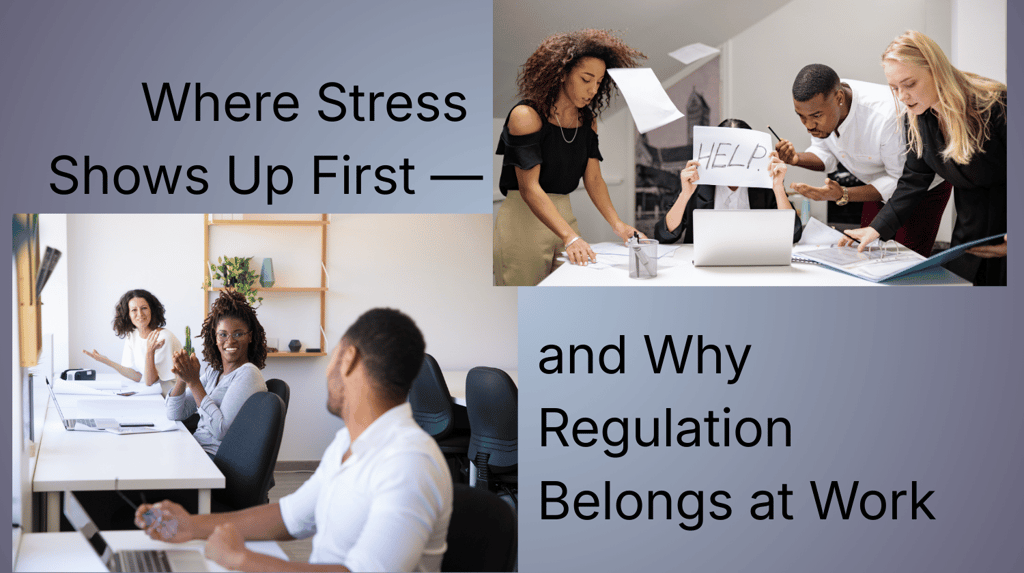
People don’t leave life at the door when they arrive at work. Health concerns, caring responsibilities, financial pressures, uncertainty and poor sleep don’t pause between meetings. When capacity is already stretched, work is where signs of stress become visible — and measurable. In Great Britain in 2024–25, an estimated 964,000 workers experienced work-related stress, depression or anxiety, resulting in around 22.1 million working days lost. On average in Scotland employees feel stressed 10 days per month.
That is why workplace wellbeing matters — not because work causes all stress, but because it is one of the first places stress can be noticed and supported in a way that benefits individuals and the organisation.
Why Stress Shows Up at Work Before Elsewhere
Stress is cumulative. It builds quietly and gradually, often long before someone recognises they are struggling.
In the workplace, this tends to show up as:
• Reduced concentration
• Emotional reactivity or withdrawal
• Difficulty coping with pressure or change
• Increasing absence or presenteeism
When people are under sustained pressure, their ability to regulate — to pause, respond thoughtfully and stay connected — is reduced. This is not a failure of resilience or motivation. It’s a natural human response to overload.
At this point, asking people to “push through”, learn new strategies, or simply talk about how they feel is rarely effective. Without first addressing regulation, these interventions struggle to land — which aligns with research showing that stress isn’t fixed by information alone but by addressing the underlying physiological response.
Where Traditional Workplace Wellbeing Can Miss the Mark
Many workplace wellbeing initiatives are thoughtful and well-intentioned — but reactive.
Support often arrives after stress has escalated into burnout, once absence has increased, or when performance has already dipped. There is also a tendency to focus on information, policies, or one-off wellbeing activities without addressing the underlying state people are operating from.
When individuals are dysregulated, overwhelmed or running on empty, they cannot integrate learning, advice or reflection — no matter how good the content.
Regulation has to come first.
A Practical Framework: Regulate → Activate → Integrate
This is the framework that underpins my wellbeing sessions — simple, repeatable, and designed to work under real-world pressure where people need something that lands quickly and practically.
Regulate — Creating Safety First
Regulation is about restoring balance in the body and nervous system. Sessions begin by supporting breath, grounding and nervous system settling — not by forcing calm, but by allowing the body to come out of constant alert.
When people feel regulated, they are better able to listen, engage and respond rather than react. Focus improves, capacity returns, and participation becomes possible.
Activate — Re-engaging Energy and Present-Moment Awareness
Once regulation has begun, energy and engagement can return.
This stage uses embodied practices that gently reawaken movement, attention and connection. This is where laughter comes in intentionally — not as humour, entertainment or performance, but as purposeful embodied practice that brings people into the present moment through the body and breath rather than asking them to search for calm in their minds.
Intentional laughter engages breath and movement in a way that supports presence and state shift. This isn’t about being funny — it’s about shifting physiology so that people can be in the moment without effort, something many find more accessible than stillness-based practices. Research on laughter and laughter yoga shows it can reduce perceived stress and support emotional resilience.
In this activation phase:
• Laughter engages breath and movement together — helping people release tension and focus in the body.
• The body cannot remain in persistent tension and fully engage in intentional breath-based laughter at the same time — the nervous system begins to shift toward regulation.
• Shared laughter strengthens connection and creates a positive group experience that reinforces focus and engagement.
Activation is not about hype — it is about bringing people back into presence in a way that feels human and accessible, making it especially effective in workplace settings where time, context and psychological safety vary.
Integrate — Letting It Land
After activation, there needs to be space.
Not to do more, learn more or fix anything — but to let the body settle and register what has just happened.
This quiet closing phase allows the nervous system to return toward balance, so people don’t leave heightened or depleted, but steady and composed.
What is carried forward isn’t a task or a technique — it’s a felt reference point. And from that place, healthier choices tend to come more easily, especially when pressure returns later in the day.
Where Laughter Fits — and Why It Works
Laughter sits at the heart of my work — but not in the way people often expect.
This is not comedy, entertainment or humour-based wellbeing. Laughter is used intentionally as a tool that changes breathing patterns, supports relaxation and helps the nervous system shift out of tension.
Because laughter is physical rather than cognitive, it can be especially effective in workplaces where time is tight, psychological safety varies, or talking-based approaches are not appropriate. Importantly, this approach does not require individuals to share personal information or disclose stressors — a key consideration for many organisations.
Research shows laughter practices can:
• Reduce perceived stress and burnout
• Decrease physiological stress indicators
• Boost positive mood and emotional resilience
• Support social connection and team cohesion
Where This Work Belongs
Workplace wellbeing doesn’t need more urgency, more information, or more expectations placed on already stretched people.
What is often missing is regulation — early, quietly and without fanfare.
Because work isn’t always the cause of stress, but it is one of the first places stress becomes visible. And that makes it one of the most appropriate places to intervene — before pressure hardens into absence, burnout or disengagement.
This work doesn’t try to fix people or ask them to push through.
It creates the conditions for steadier focus, better connection and more capacity — right at the point where stress first shows itself.
That is where it sits.
Not as a solution to everything, but as a calm, preventative layer of support that helps people stay well enough to keep going.